History & Comments
Back
Initial creation
Description:Research-directions map from Google Scholar publication history
# THz Wavefront Engineering
⏎
**Anchor paper:** A.W. Schiff-Kearn, L. Gingras, S. Bernier, N. Chamanara, K. Agarwal, et al., "Front-induced transitions control THz waves," *Communications Physics* 4, 162 (2021). [arXiv:2102.02879]
⏎
## Background
Terahertz (THz) pulses are central to spectroscopy, imaging, and emerging wireless communications, but shaping their waveform — stretching, compressing, reversing, or frequency-converting — has conventionally relied on static nonlinear-optical media requiring intense THz fields. Open question: could a dynamically engineered, moving medium manipulate THz waves more directly? One route: photoexcite a sheet of free carriers ("front") sweeping through a semiconductor waveguide at a controllable, potentially relativistic velocity — a regime not yet experimentally realized or systematically characterized for THz control.
⏎
## New results
The authors introduce SLIPSTREAM: relativistically moving photoionization fronts in a silicon-filled parallel-plate waveguide, generated by a near-infrared pump pulse, used to directly manipulate a co-propagating THz wave. In the sub-luminal regime, the interaction produces temporally stretched, quasi-static THz plateau pulses lasting several picoseconds, tunable via the front's interaction distance and carrier density. In the super-luminal regime, the front induces an intra-band transition in the wave's dispersion relation that performs a time-reversal operation on the THz waveform, along with non-reciprocal wave behavior — confirmed via both simulated dispersion analysis and time-resolved THz measurements.
⏎
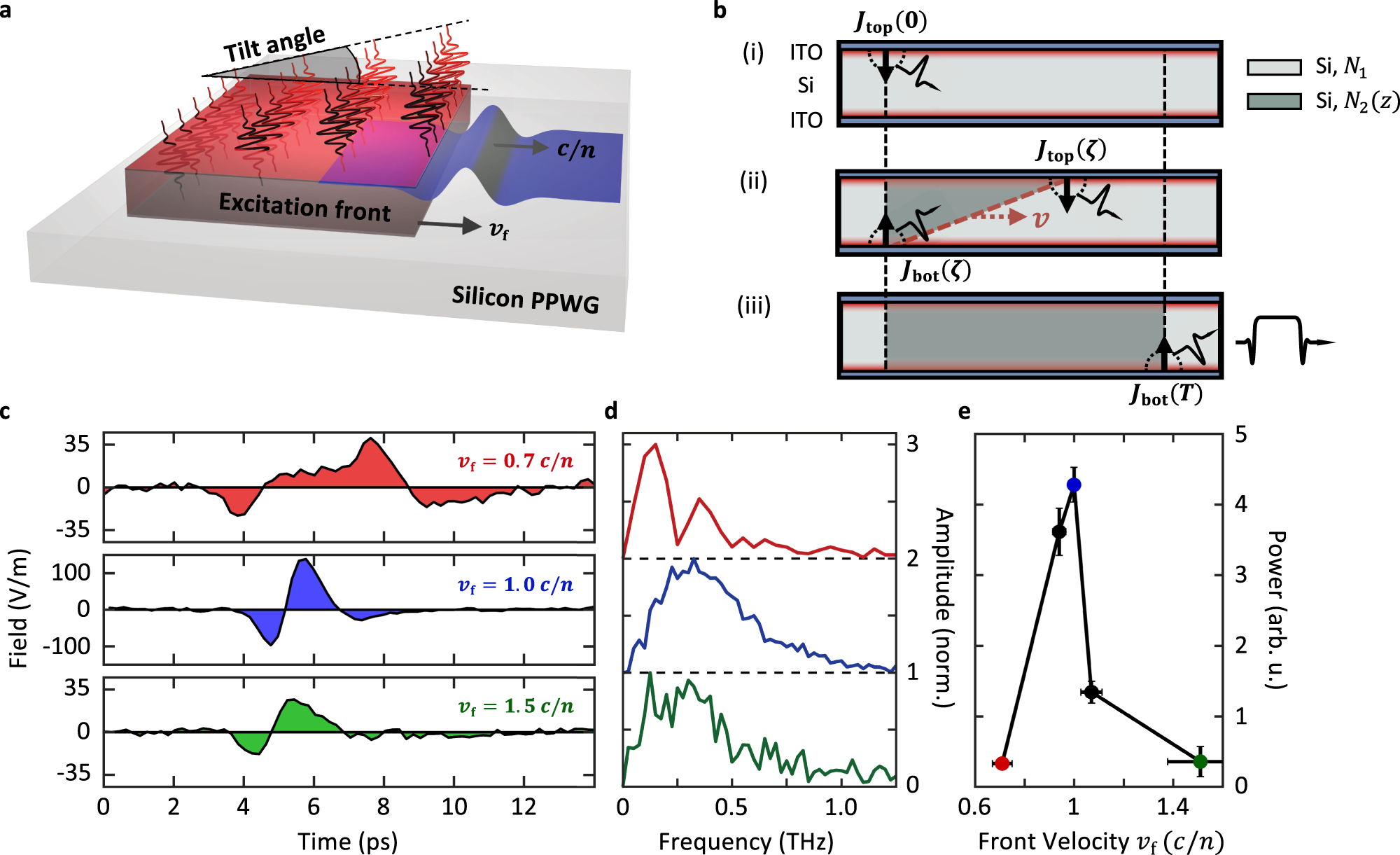
*Fig. 1 — schematic of the SLIPSTREAM platform: a near-IR pump pulse photoinjects a moving carrier front in a silicon-filled waveguide, generating tunable THz plateau pulses across sub-luminal, luminal, and super-luminal front-velocity regimes.*
⏎
## Related work in this direction
- "Steering the Slipstream: Moving Fronts to Tailor Terahertz Pulses," CLEO: Science and Innovations (2021).
- "Tailoring Terahertz Pulses with Moving Fronts: Temporal Stretching and Time-Reversal," IRMMW-THz conference (2020).
⏎
This is a genuinely separate applied-photonics excursion from Agarwal's quantum many-body theory, connected mainly by an abstract idea: the same "engineered moving front outrunning a system's natural signal velocity" trick that drives **Engineered Spacetime Quenches for Critical-State Preparation**, here applied to classical nonlinear optics instead of quantum many-body state preparation.
⏎
⏎
# Parents
⏎
* Nonequilibrium Protocols & Wavefront Engineering⏎
Sign in to add a new comment