History & Comments
Back
Initial creation
Description:Research-directions map from Google Scholar publication history
# Nanoscale Probes of Symmetry-Breaking & Axion-like Response ⏎ **Anchor paper:** S.J. De, K. Agarwal, T. Pereg-Barnea, "Nanoscale defects as probes of time-reversal symmetry breaking," *Phys. Rev. X* 16, 011001 (2026). [arXiv:2406.14648] ⏎ ## Background Time-reversal symmetry breaking (TRSB) — from hidden loop currents, altermagnetism, chiral superconducting pairing, or fractional quantum Hall order — is often subtle and confined to short length scales, making it hard to detect with bulk probes (transport, global susceptibility, neutron scattering) that average over macroscopic volumes. Open question: could a local, non-invasive nanoscale sensor — an NV center in diamond, naturally coupling to magnetic-field noise at wavevectors set by its distance from the sample — directly access the microscopic chirality of TRSB-driven fluctuations that bulk techniques cannot resolve? ⏎ ## New results The authors show an NV center's spin relaxation rates from its two upper sublevels acquire a difference proportional to the Hall (dissipative) part of the material's conductivity, vanishing identically unless time-reversal symmetry is broken — a direct, background-free order parameter for TRSB. Physically, a TRSB sample radiates magnetic noise with different spectral weight for left- vs. right-circularly-polarized fluctuations, sensed asymmetrically by the NV center depending on its orientation. Computed for quantum Hall systems (isolating Hall viscosity) and chiral d-wave superconductivity in twisted BSCCO junctions, the theory predicts a concrete "Hebel-Slichter-like" enhancement just below Tc plus a nonzero differential rate appearing only for chiral pairing — a practical protocol to distinguish pairing symmetries at realistic NV-to-sample distances (~20 nm). ⏎ 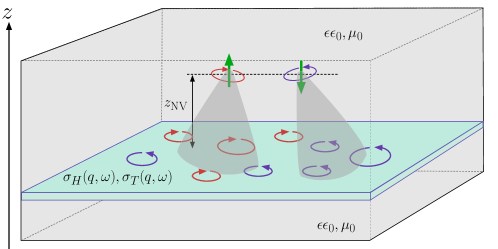 *Fig. 1 — an NV center oriented toward vs. away from a TRSB sample senses magnetic-field noise of opposite circular polarizations, producing a differential relaxation rate that vanishes unless time-reversal symmetry is broken.* ⏎ ## Related work in this direction - M. Smith, K. Agarwal, I. Martin, "Theory of Stimulated and Spontaneous Axion Scattering," PRL 136, 076903 (2026) — extends the same philosophy (a localized, dynamically responsive probe rather than a bulk measurement) to the topological electromagnetic response of axion-like matter. ⏎ This node sits under **Noise Magnetometry** as a direct methodological descendant: both use a local quantum sensor's noise/relaxation signature to diagnose exotic electronic behavior invisible to bulk probes. ⏎ ⏎ # Parents ⏎ * Noise Magnetometry as a Probe of Correlated Electron Dynamics⏎
Sign in to add a new comment